
Custom Sculpture Fabrication for Shopping Malls: From Concept to Installation
COMMERCIAL SPACE ART INSTALLATION / IP EXHIBITION FABRICATION
10/9/20269 min read
Custom Sculpture Fabrication for Shopping Malls: From Concept to Installation
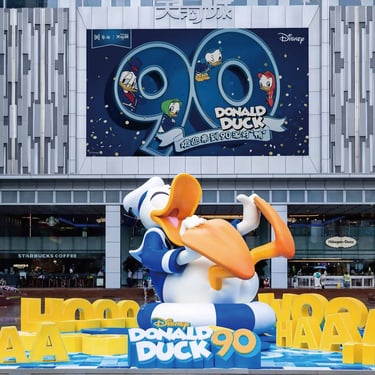


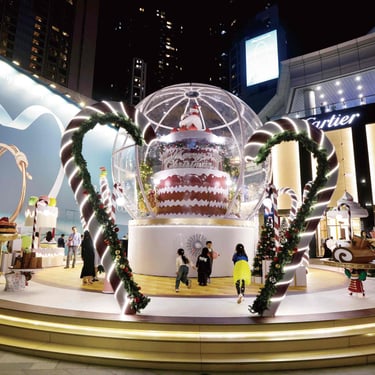
A shopping mall is more than a collection of retail spaces.
Today, major commercial destinations are increasingly designed around memorable experiences—landmark atriums, immersive environments, seasonal installations, branded sculptures, interactive displays and large-scale artworks that encourage visitors to stop, photograph and share.
A well-designed sculpture can become one of the most recognisable visual elements within a shopping mall.
But creating a large sculpture for a commercial environment requires much more than producing an attractive object.
The sculpture needs to work with the architecture, fit the available space, meet structural and safety requirements, survive the intended display period and be transported and installed without disrupting normal mall operations.
This is where a specialist custom sculpture manufacturer for shopping malls becomes important.
From concept development and material selection to structural engineering, fabrication, finishing, logistics and installation, every stage needs to be considered as part of one coordinated process.
DEFARA works across commercial art installations, large-scale sculpture fabrication, retail environments and branded experiences, helping transform creative concepts into physical installations for shopping centres and other commercial destinations.
Why Do Shopping Malls Use Custom Sculptures?
A custom sculpture can serve several different purposes within a commercial development.
It may become a permanent architectural landmark, a seasonal attraction, an IP activation, a promotional installation or a visual focal point within an otherwise open space.
Common applications include:
Atrium sculptures
Entrance landmarks
Suspended installations
Façade sculptures
Lobby and circulation-area artworks
Seasonal installations
Brand activation displays
Character and IP sculptures
Interactive installations
Social-media photo opportunities
In each case, the sculpture needs to do more than fill space.
It needs to communicate something about the destination.
A luxury shopping centre may require refined metallic surfaces and architectural integration. A family-oriented mall may use colourful character sculptures. A seasonal campaign may require a large temporary installation that can be fabricated, installed, dismantled and potentially relocated.
The creative objective therefore determines the fabrication strategy.

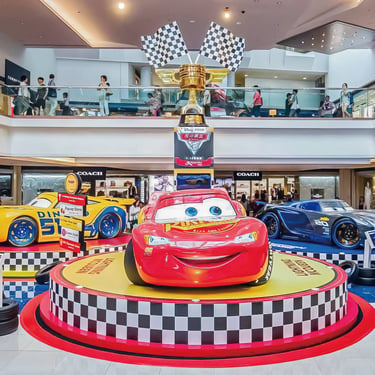

What Makes Shopping Mall Sculpture Fabrication Different?
A sculpture installed in a shopping mall operates in a very different environment from a sculpture displayed in a private studio or gallery.
The installation may be surrounded by thousands of visitors every day.
It may sit beneath a large atrium, next to escalators, above a retail floor or in a highly visible entrance area.
At the same time, the mall usually needs to remain operational during installation.
This creates several important considerations.
Architecture and Spatial Integration
The sculpture must fit the architectural environment.
Its dimensions, proportions, colours, materials and viewing angles should work with the surrounding space rather than compete with it unintentionally.
Public Safety
Because visitors may approach the sculpture closely, the design needs to consider structural stability, access, sharp edges, connections, surface durability and other safety requirements.
Installation Access
A sculpture may need to pass through loading bays, service corridors, doors, elevators or restricted access routes before reaching its final location.
For very large installations, modularisation may be necessary from the beginning.
Operational Constraints
Shopping malls are active commercial environments.
Installation work may need to take place overnight or during restricted access periods to minimise disruption to tenants and visitors.
Brand and Visual Standards
For branded or luxury retail projects, colour accuracy, surface quality and material consistency can be as important as the physical structure.
These requirements make shopping mall sculpture fabrication a multidisciplinary process.
Where Can Custom Sculptures Be Used in a Shopping Mall?
Atrium Sculptures
The atrium is often the most visually prominent area of a shopping mall.
A large central sculpture can be seen from multiple floors and circulation routes, making it an effective visual landmark.
Atrium projects may include:
Suspended sculptures
Large character installations
Seasonal landmarks
Kinetic artworks
Brand icons
Large-scale decorative structures
The vertical scale of an atrium can also create an opportunity for sculptures that would not be possible in a conventional retail space.
However, the greater the height, the more important structural engineering, lifting, access and installation planning become.
Entrance and Plaza Sculptures
Outdoor entrances and plazas can use large sculptures to establish a visual identity before visitors enter the building.
These sculptures may function as:
Gateway landmarks
Branded installations
Public art
Seasonal displays
Character sculptures
Photo opportunities
Outdoor applications require additional consideration of environmental exposure, including sunlight, rain, wind and temperature changes.
The material and finish therefore need to be selected according to the expected installation conditions.
Facade and Suspended Installations
Some mall projects use sculpture as part of the building itself.
Large characters, objects or branded forms can be suspended from architectural structures or integrated into facades.
These projects require particularly close coordination between the fabrication team, structural engineers, architects and site contractors.
The visible sculpture may appear simple, but its supporting system can be highly technical.
Interior Public Spaces
Not every mall sculpture needs to be monumental.
Smaller custom sculptures can become focal points in:
Luxury retail zones
Hotel-connected areas
Restaurants
Children's spaces
Event zones
Pop-up environments
Brand activation areas
In these applications, scale may be smaller, but surface quality and design integration can become even more important.

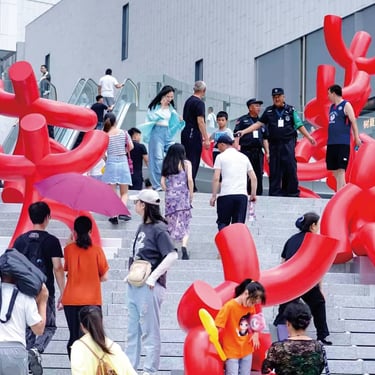


From Concept to Production: How a Mall Sculpture Is Developed
Although each project is different, the process usually begins well before fabrication.
1. Concept Review and Feasibility
The fabrication team first reviews the available creative information.
This may include:
Sketches
Renders
3D models
Architectural drawings
Dimensions
Material references
Site photographs
At this stage, the key question is:
Can the proposed sculpture be manufactured, transported and installed within the actual mall environment?
Potential issues should be identified before production begins.
2. 3D Modelling and Technical Development
For complex forms, digital modelling helps translate the creative concept into production data.
The model may need to be adjusted for:
Scale
Wall thickness
Internal structure
Modular divisions
Connection points
Manufacturing processes
Transportation dimensions
For character-based projects, maintaining the original proportions is particularly important.
Scaling a small character into a multi-metre sculpture is not simply a matter of making everything larger.
Details, proportions and surface transitions need to remain visually correct at architectural scale.
3. Structural Engineering
Large mall sculptures are both artworks and physical structures.
Depending on the installation, engineering may need to consider:
Self-weight
Internal support structures
Load distribution
Connection points
Lifting points
Anchoring
Building interfaces
Suspended loads
Visitor safety
Suspended sculptures require particularly careful coordination with the building structure.
The sculpture itself may be lightweight, but the supporting and connection systems must be designed according to the actual installation conditions.
4. Prototyping and Approval
Before full production, a project may require samples, prototypes or material tests.
This can be particularly important for branded or IP-driven installations.
Approval may cover:
Sculptural proportions
Surface details
Colour
Material
Finish
Lighting
Structural appearance
A controlled approval process allows potential issues to be identified before full-scale manufacturing begins.

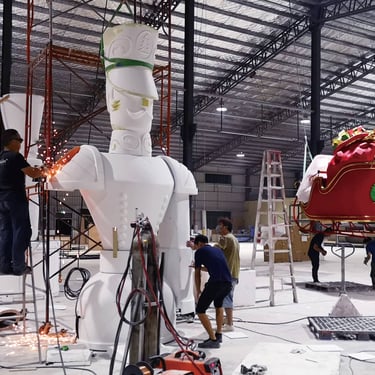

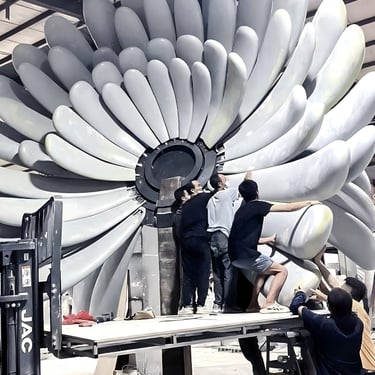
5. Fabrication and Surface Finishing
Once the design and technical details are approved, full-scale fabrication begins.
Depending on the project, production may involve:
CNC machining
Industrial 3D printing
Mould-making
Fiberglass production
Metal fabrication
Welding
Sculptural assembly
Painting
Polishing
Electroplating
Texturing
Lighting integration
The final finish can significantly influence the appearance of the sculpture.
For a premium retail environment, surface imperfections that might be acceptable in a temporary display may not meet the required standard.
Quality control therefore needs to continue throughout production and finishing.
6. Factory Trial Assembly
For large or modular sculptures, trial assembly at the factory can reduce installation risks.
The sections can be assembled before shipping to check:
Overall dimensions
Module connections
Alignment
Surface transitions
Structural interfaces
Lighting or mechanical systems
Installation sequence
This is particularly valuable when the final installation site has limited access or a restricted installation window.
7. Transportation to the Shopping Mall
A large sculpture cannot always be transported as one piece.
The fabrication team may need to divide the sculpture into modules that are:
Manufacturable
Transportable
Liftable
Reassemblable
Structurally secure
Transportation dimensions can therefore influence the sculpture's engineering from the beginning.
For international projects, export packing and logistics planning also need to be considered.
8. On-Site Installation
Installation is the final stage where the fabrication strategy meets the real shopping mall environment.
Depending on the project, installation may involve:
Cranes
Rigging
Scaffolding
Lifting equipment
Temporary supports
Structural connections
Electrical connections
Alignment
Final finishing
For operational shopping malls, installation may be scheduled during overnight hours or other restricted access periods.
The objective is not simply to place the sculpture in position.
It must be assembled accurately, safely and with minimal disruption to the surrounding commercial environment.


How DEFARA Approaches Shopping Mall Sculpture Fabrication
DEFARA combines public art fabrication, large-scale sculpture manufacturing and retail experience fabrication within one coordinated production system.
Its current commercial-space capabilities include atrium sculptures, lobby centerpieces, façade art and seasonal brand activations, while its fabrication network supports fiberglass, composites, stainless steel, aluminium, structural steel, CNC production, industrial 3D printing, mould-making, premium finishing and technical integration.
This allows a shopping mall project to be approached as a complete physical environment rather than as an isolated sculpture.
The team can work from a concept, render, maquette or 3D file and support technical development, material selection, structural coordination, prototyping, fabrication, finishing, modular transportation and installation planning.
For commercial projects, this integrated approach can help reduce the number of technical interfaces between design, manufacturing, logistics and installation.
Shopping Mall Sculpture Projects by DEFARA
Dubai Mall: Monumental Christmas Installation
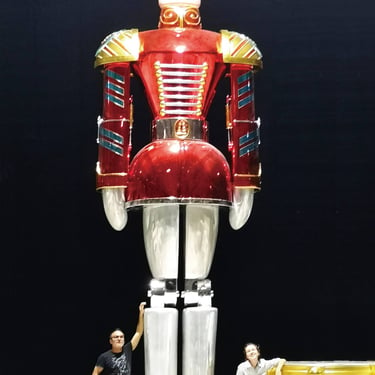
One of DEFARA's recent commercial mall projects was a monumental Christmas installation at Dubai Mall.
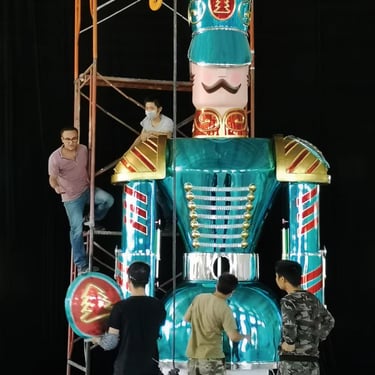
The project featured four approximately 10-metre electroplated Christmas soldier sculptures together with a giant suspended Christmas bauble installation in the mall's Star Atrium.
The sculptures used modular construction, internal structural systems and high-gloss electroplated metallic finishes designed for a premium retail environment.
The project required creative engineering, structural development, large-scale fabrication, finishing, logistics coordination, installation support and quality control.
This project demonstrates how a shopping mall installation can combine monumental scale, architectural integration, premium finishing and complex installation logistics.
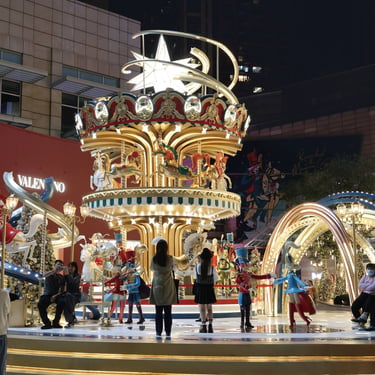
ELEMENTS Hong Kong × Tiffany & Co.: Luxury Retail Installation
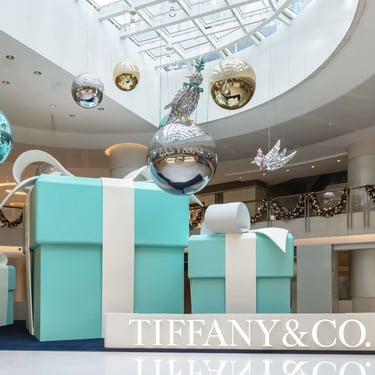
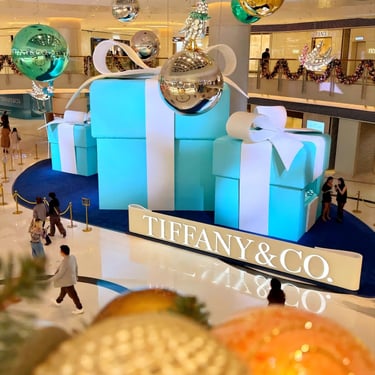
For “The Delight of Gifting” at ELEMENTS Hong Kong, DEFARA fabricated a large-scale Christmas installation inspired by Tiffany & Co.'s visual language.
The installation included a more than four-metre Tiffany Blue Box structure and Bird on a Rock-inspired elements within the mall atrium.
Rather than functioning simply as decoration, the gift-box structure was developed as an experiential environment that visitors could enter.
The project combined FRP manufacturing, metal finishing, structural engineering, luxury retail display fabrication and installation support.
This illustrates another important category of mall sculpture:
turning a brand symbol into a physical destination.
POP MART Wuhan Joy City: IP and Immersive Retail Experience
At Wuhan Joy City, DEFARA supported the first POP MART Family Exhibition in Wuhan.
The project brought together multiple designer-toy IPs across seven themed zones and eight interactive installations, combining large-scale character sculptures with immersive environments.
The project demonstrates how sculpture fabrication can become part of a wider retail experience rather than functioning as a standalone object.
For shopping malls, this type of installation can connect sculpture, brand storytelling, visitor interaction and commercial experience within one environment.
What Should You Look for in a Shopping Mall Sculpture Manufacturer?
Choosing a manufacturer should involve more than comparing fabrication prices.
Experience With Large-Scale Commercial Projects
Look for projects completed in environments similar to your own:
Shopping malls
Retail destinations
Atriums
Commercial plazas
Luxury retail environments
Branded spaces
Experience with the same environment can help the fabrication team anticipate access, installation and operational constraints.
Engineering and Fabrication Under One System
A large sculpture should not be treated as an artwork first and an engineering problem later.
Technical development should happen before production.
The manufacturer should be able to consider:
Materials
Structure
Weight
Modularisation
Connections
Transportation
Installation
as one coordinated system.
Multi-Material Capability
Commercial sculptures often combine several manufacturing processes.
A project may require fiberglass, stainless steel, structural steel, CNC components, lighting and specialist finishing.
A multi-material fabrication partner can reduce coordination between separate suppliers.
Installation Experience
A sculpture that looks perfect in the factory still needs to work on site.
Ask whether the manufacturer can support:
Packing
Transportation
Installation planning
Rigging
Assembly
Alignment
Final finishing
For large mall installations, on-site experience can be just as important as manufacturing capability.
Quality Control and Approval
Commercial and branded projects often involve several approval stages.
These may include:
3D model approval
Prototype approval
Colour approval
Material samples
Surface finish samples
Factory trial assembly
Final quality inspection
A clear approval process can reduce production risk and protect the final visual result.
How Much Does a Shopping Mall Sculpture Cost?
There is no standard price for a custom mall sculpture.
The final cost can depend on:
Sculpture size
Geometry
Material
Structural requirements
Surface finish
Quantity
Lighting or mechanical integration
Modularisation
Transportation
Installation
Project schedule
A five-metre character sculpture, a polished stainless-steel landmark and a suspended seasonal installation may have completely different production costs even when their dimensions are similar.
For an accurate quotation, it is useful to provide the manufacturer with the concept, approximate dimensions, installation location, material preference, finish requirements, quantity and required completion date.
For more detailed information about sculpture pricing, see DEFARA's guide to How Much Does Custom Sculpture Fabrication Cost?


Frequently Asked Questions
What types of sculptures can be made for shopping malls?
Shopping malls can use atrium sculptures, character sculptures, branded installations, public art, suspended artworks, seasonal displays, façade sculptures, interactive installations and landmark pieces.
What is the best material for a shopping mall sculpture?
There is no single best material. Fiberglass is often suitable for large character sculptures and complex painted forms, while stainless steel can be appropriate for polished or architectural sculptures. Mixed-material systems can also combine different advantages.
Can a large sculpture be installed inside an operating shopping mall?
Yes. However, installation planning needs to consider access routes, lifting equipment, working hours, visitor safety and coordination with mall operations. Large projects may require modular construction and overnight installation.
Can sculptures be suspended inside a shopping mall atrium?
Yes, but suspended installations require careful structural coordination. The sculpture, attachment system and building connection points all need to be considered during engineering.
Can custom mall sculptures be produced for temporary events?
Yes. Temporary seasonal displays, exhibitions, brand activations and promotional installations can be designed for installation, dismantling and potential relocation.
Can DEFARA manufacture sculptures from a 3D model?
Yes. A 3D model can be used as a starting point for digital development, engineering and fabrication. Depending on the project, additional modelling, structural development, mould-making, CNC machining or industrial 3D printing may be required.
Does DEFARA provide installation support?
Depending on the project scope, DEFARA can support modular delivery planning, logistics, installation coordination and on-site installation for large-scale commercial and public artworks.



Conclusion: From Mall Decoration to Commercial Landmark
A successful shopping mall sculpture is more than a large decorative object.
It needs to work simultaneously as art, architecture, engineering and visitor experience.
From an atrium landmark to a branded character installation, every project requires a coordinated approach to concept development, material selection, structural engineering, fabrication, finishing, transportation and installation.
The right fabrication partner can help identify technical challenges before production begins, develop a practical manufacturing strategy and ensure that the final sculpture works in the real commercial environment.
DEFARA combines sculpture fabrication, engineering, retail display production and installation capabilities to help shopping malls, developers, brands and creative agencies turn ambitious concepts into physical destinations.
Have a shopping mall sculpture or commercial art installation in development?
Send DEFARA your concept, render, drawing or 3D model. The team can review the fabrication requirements and help develop a practical route from concept to installation.


Adelaide
Chengdu


DEFARA © 2026
8 TEMASEK BOULEVARD
#08-05, SUNTEC TOWER THREE
038-998 SINGAPORE
Singapore


30 PIRIE STREET
ADELAIDE 5000 SA
AUSTRALIA
1210 FU NIAN PLAZA
HIGH TECH DISTRICT CHENGDU
610000 CHINA
SUITE 703, NORTH TOWER
1-5 RAILWAY STREET
CHATSWOOD 2067
AUSTRALIA
Sydney