
How Are Large-Scale Sculptures Made? A Complete Fabrication Process
PUBLIC ART FABRICATION / LARGE-SCALE SCULPTURE MANUFACTURING
9/11/202611 min read
How Are Large-Scale Sculptures Made? A Complete Fabrication Process


A large-scale sculpture may look like a single finished object, but behind the visible surface is a carefully coordinated process involving design development, digital modelling, structural engineering, material fabrication, finishing, transportation and installation.
So, how are large-scale sculptures made?
The answer depends on the artwork, material, scale and installation environment. A sculpture created for an indoor exhibition may follow a very different production route from a monumental outdoor artwork. A character sculpture may require mould-making and detailed painting, while a contemporary stainless-steel artwork may depend on precision metal forming and polishing.
In professional large scale sculpture fabrication, however, the overall process usually follows a connected sequence:
Concept → 3D Development → Engineering → Prototype → Mould & Fabrication → Finishing → Assembly → Transportation → Installation
The key is not simply completing each stage individually. Every stage must work with the next one.
At DEFARA, sculpture production brings together creative interpretation, digital development, structural thinking, material fabrication, finishing and project installation to transform concepts and digital models into large physical artworks.
1. Concept and Fabrication Feasibility
Every large sculpture begins with a creative idea.
The starting point may be:
an artist's sketch;
a physical maquette;
a 3D model;
a conceptual render;
architectural drawings;
a character design; or
an existing artwork that needs to be enlarged.
Before fabrication begins, the production team needs to understand not only what the sculpture should look like, but also how it needs to function as a physical structure.
Several questions need to be considered at this stage:
How large will the finished sculpture be?
Where will it be installed?
Will it be indoors or outdoors?
What material is appropriate?
How will the sculpture be transported?
Does it need to be divided into modules?
How will it be lifted and assembled?
What structural support will be required?
What level of surface detail and finishing is expected?
This early feasibility stage is critical because decisions made at the beginning can influence almost every later production step.
A design that looks straightforward on screen may become significantly more complex when enlarged to several metres in height.
The goal is therefore to identify potential manufacturing and installation challenges before production begins.


2. 3D Modelling and Digital Sculpture Development
For complex large-scale sculptures, digital modelling provides a bridge between creative design and physical production.
When a sculpture begins with a small maquette or existing digital artwork, the geometry may need to be developed or enlarged digitally before fabrication.
This stage can involve:
3D scanning;
digital sculpting;
CAD development;
surface optimisation;
scale enlargement;
segmentation; and
integration of structural requirements.
From Maquette to Monument
Scaling a sculpture is not simply a matter of multiplying every dimension.
A small sculpture may contain details that need to be adjusted when the artwork becomes several metres tall. Surface transitions, proportions, joints and visual details can behave differently at architectural scale.
Digital development allows the fabrication team to examine the sculpture before committing to full-scale production.
It also makes it possible to divide a large sculpture into manageable production sections.
For example, instead of manufacturing one enormous object, the sculpture may be developed as multiple engineered modules that can later be assembled into a seamless final form.
This approach becomes particularly important when the finished artwork needs to be transported internationally.
3. Structural Engineering
A large sculpture is not only an artwork.
It is also a structure.
As scale increases, the internal system becomes increasingly important.
Depending on the project, structural development may need to consider:
self-weight;
centre of gravity;
wind loading;
seismic requirements;
foundations;
anchoring;
internal steel frameworks;
connection points;
lifting points;
access panels;
drainage; and
maintenance access.
For outdoor monumental sculpture fabrication, these considerations become particularly important because the finished sculpture may need to withstand changing environmental conditions over an extended period.
The Structure Behind the Artwork
In many finished sculptures, the internal engineering is almost invisible.
The viewer sees the artistic surface rather than the structural system supporting it.
This is exactly what successful engineering should achieve: the structure provides the required stability and strength without compromising the visual language of the artwork.
For complex projects, engineering therefore needs to happen alongside design development rather than being treated as something added after the sculpture has already been fabricated.
4. Prototype and Approval
Before full production begins, a prototype or representative sample may be required.
This is especially useful for projects involving:
highly detailed characters;
complex organic forms;
unusual surface treatments;
custom colours;
specialist finishes; or
high-profile branded or IP artworks.
A prototype gives the creative team and client an opportunity to review the physical result before committing to full-scale production.
Approval stages can include:
digital model approval;
prototype approval;
material samples;
colour samples;
representative finishing samples; and
factory trial assembly.
These approval points reduce the risk of discovering major visual or technical issues after full production has begun.
For artist-led projects, this stage can also help confirm that the physical manufacturing process is preserving the original creative intention.


5. Mould Making and Fabrication
Once the design, engineering and approvals are complete, the sculpture can move into physical production.
The exact manufacturing process depends on the selected material and geometry.
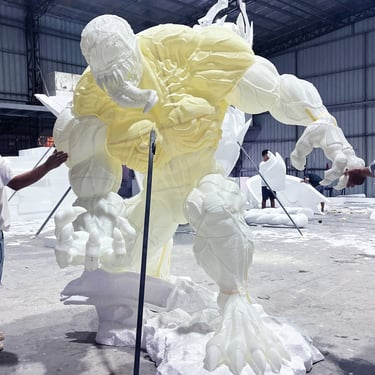
For fiberglass and composite sculptures, mould-making is often an important part of the production process.
Fiberglass / FRP Sculpture Fabrication
Fiberglass reinforced plastic, commonly referred to as fiberglass or FRP, is particularly useful for large lightweight sculptures and complex organic forms.
It can reproduce detailed surfaces and is suitable for:
character sculptures;
commercial installations;
themed environments;
large lightweight forms; and
sculptures requiring detailed painted finishes.
A typical fiberglass production route may involve developing the production model, creating the mould, forming the fiberglass shell and integrating the required internal structure.
The result can provide a relatively lightweight sculptural surface while maintaining complex geometry.
Metal Sculpture Fabrication
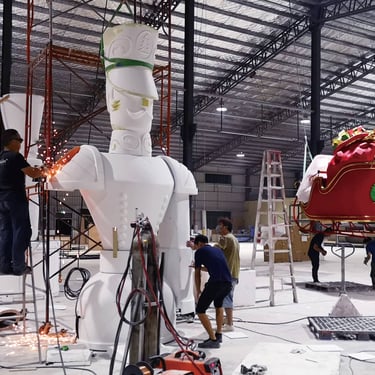
For stainless steel, aluminium, corten steel and other metal sculptures, the fabrication route is different.
Depending on the design, production can involve:
metal forming;
cutting;
welding;
grinding;
polishing;
structural fabrication; and
surface treatment.
Stainless-steel sculptures with polished or reflective surfaces require particularly careful fabrication because surface imperfections can become highly visible in the final artwork.
Mixed-Material Fabrication
Large sculptures do not always rely on one material.
A single project may combine:
steel structure + fiberglass shell + CNC-machined components + integrated lighting + specialist surface finishing.
This allows the fabrication system to be selected according to the requirements of different parts of the artwork.
The objective is not to force every sculpture into one manufacturing method, but to determine the most appropriate combination of materials and processes.
6. Surface Finishing and Colour
Fabrication creates the physical sculpture, but finishing determines much of what the audience ultimately sees.
Surface finishing can include:
sanding;
surface preparation;
priming;
painting;
colour matching;
polishing;
protective coatings;
specialist textures; and
other decorative treatments.
For character and IP sculptures, colour accuracy and surface appearance can be particularly important.
A sculpture may have technically correct dimensions but still fail to meet the creative requirement if its colours, texture or surface treatment are incorrect.
For this reason, finishing should be treated as an integral part of the fabrication process rather than simply the final cosmetic step.
For outdoor projects, the finishing system may also need to provide appropriate protection against environmental exposure.
The final specification depends on the sculpture's location, material and intended use.
7. Trial Assembly and Quality Control
Large sculptures are often manufactured in multiple sections.
Before shipping to the final destination, these components may need to be assembled at the factory.
This is known as trial assembly or factory assembly.
The purpose is to verify:
dimensional accuracy;
connections;
alignment;
module interfaces;
structural components;
surface continuity;
installation sequence; and
overall appearance.
Trial assembly is particularly valuable for large sculptures because correcting an issue in the factory is usually easier than correcting it after the sculpture has arrived on site.
It also allows the production team to understand the actual assembly sequence before installation begins.
For international projects, this can be an important quality-control stage between manufacturing and overseas delivery.


8. Modularisation for Transportation
A sculpture may be designed as one continuous form visually, but it does not necessarily need to travel as one physical piece.
Large-scale sculpture fabrication often requires the artwork to be divided into transportable modules.
This is particularly important when a sculpture needs to fit within:
shipping containers;
specialised trucks;
airfreight systems; or
restricted site access routes.
The modular structure needs to balance two requirements:
It must be practical to manufacture and transport while remaining visually seamless after assembly.
This means connection points and module divisions need to be considered during the engineering and digital development stages.
The final sections must be designed so they can:
be manufactured accurately;
be transported safely;
be lifted efficiently;
reconnect correctly; and
minimise visible connection lines.
For international sculpture fabrication and installation, transportation is therefore not an afterthought.
It is part of the sculpture's engineering strategy.
9. Transportation and Logistics
Once the sculpture has passed production and quality-control stages, it can be prepared for delivery.
For large artworks, logistics may involve:
protective packing;
modular identification;
loading plans;
container planning;
specialised transport;
international shipping; and
coordination with the destination site.
The larger the sculpture, the more closely fabrication and logistics become connected.
A sculpture that cannot pass through the required transport route is not a practical sculpture, regardless of how successful its manufacturing may be.
This is why transportation requirements should ideally be considered during the earliest stages of large-scale sculpture development.
10. On-Site Installation
The final stage is installation.
This is where the manufactured components become one finished artwork within its intended environment.
Depending on the scale and location, installation may require:
cranes;
rigging;
temporary support structures;
scaffolding;
lifting calculations;
engineering supervision;
night installation; and
coordination with building or site contractors.
For a shopping mall installation, for example, the work may need to be completed within restricted access hours to avoid disrupting normal operations.
For outdoor monumental sculptures, weather conditions and site access can influence lifting and installation schedules.
For suspended sculptures, attachment points and building load capacity also become critical considerations.
The installation team therefore needs to understand the sculpture before it arrives on site.
The more complex the project, the more important it becomes to plan installation during the design and fabrication stages.
11. Final Inspection and Handover
After installation, the completed sculpture needs to be checked against the approved design and project requirements.
The final review may consider:
overall dimensions;
alignment;
surface quality;
colour and finish;
structural connections;
installation details; and
the appearance of the sculpture within its environment.
At this point, the individual stages of production finally become one finished physical experience.
What began as a sketch, render, maquette or digital model has become a large-scale sculpture that can occupy a public or architectural space.


A Complete Large-Scale Sculpture Fabrication Workflow
The entire process can therefore be summarised as:
1. Concept & Feasibility
Understand the artwork, scale, location and production requirements.
2. 3D Modelling & Development
Create or refine accurate digital production data.
3. Structural Engineering
Develop the internal structure, connections and installation requirements.
4. Prototype & Approval
Verify the physical appearance, materials, colours and details.
5. Mould Making & Fabrication
Produce the sculpture using fiberglass, metal, composites or a combination of materials.
6. Surface Finishing
Apply colour, texture, polishing, protective coatings and other required finishes.
7. Trial Assembly & Quality Control
Check modules, dimensions, connections and overall appearance before delivery.
8. Modular Packing & Transportation
Prepare the sculpture for safe domestic or international transportation.
9. On-Site Installation
Assemble, lift and secure the sculpture in its final environment.
10. Final Inspection
Confirm the completed artwork meets the approved design and project requirements.
The exact sequence may change from project to project, but the principle remains the same:
Large-scale sculpture fabrication is an integrated process, not a single manufacturing step.
What Makes Large-Scale Sculpture Fabrication Challenging?
The larger a sculpture becomes, the more disciplines need to work together.
A small object can often be produced with relatively simple tools and processes.
A sculpture several metres high may require coordination between:
artist + designer + 3D modeller + structural engineer + fabricator + finishing team + logistics team + installation team.
The creative challenge is preserving the original design.
The engineering challenge is making it structurally viable.
The manufacturing challenge is producing the required geometry accurately.
The logistics challenge is moving the finished components to the destination.
The installation challenge is assembling everything safely and accurately on site.
This is why choosing a large scale sculpture manufacturer is not simply about finding a company that can physically make a large object.
It is about finding a partner capable of connecting the entire process.



Large-Scale Sculpture Fabrication in Practice
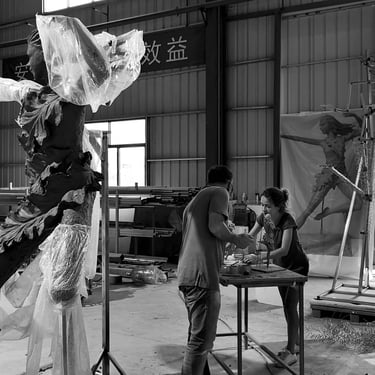
DEFARA's projects demonstrate how different fabrication requirements can come together at monumental scale.
Qatar World Cup Giant Emblem
The Qatar World Cup Giant Emblem project illustrates the complexity of combining monumental scale, digital development, structural engineering, fabrication, logistics and installation support under an extremely demanding deadline.
The finished structure measured approximately 24 × 14 × 27 metres, requiring coordinated 3D modelling, structural development, fabrication, logistics and installation support.
At this scale, the sculpture is no longer simply an object.
It becomes architecture.
Disney 100th Anniversary Exhibition
Character-based fabrication introduces a different set of requirements.
For the Disney 100th Anniversary Exhibition, DEFARA supported fabrication of character elements and immersive environments for a touring exhibition programme.
The physical elements needed to maintain accurate proportions, expressions, colours and finishes while also being suitable for dismantling, transportation and repeated installation.
This demonstrates another essential aspect of large-scale sculpture manufacturing:
creative accuracy must work together with real-world engineering and operation.
Hirono “Reshape”
Artist-led projects require another type of precision.
DEFARA's portfolio includes the approximately eight-metre Hirono “Reshape” landmark created for the Aranya beach environment.
Scaling an artistic language from a small character into an architectural-scale sculpture requires careful consideration of proportion, texture, joints, structure and visual perception.
A detail that works at small scale may behave very differently when enlarged several metres.
The fabrication process therefore has to preserve the character of the original artwork while adapting it to its physical environment.
SPACE MOLLY
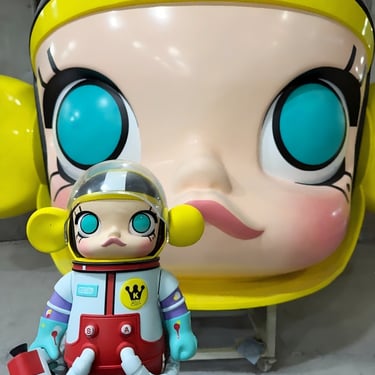
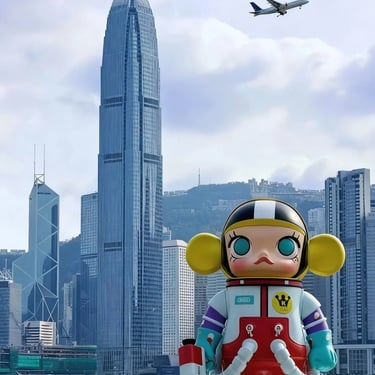
DEFARA has also produced large-scale SPACE MOLLY sculptures, including a six-metre fiberglass installation in Hong Kong.
These projects demonstrate how a character originally experienced at collectible scale can become a landmark physical installation.
The challenge is not simply making the sculpture larger.
It is maintaining the visual identity of the original character while adapting its construction, structure, surface and installation requirements to a much larger scale.
Why Early Fabrication Planning Matters
One of the most important lessons in large-scale sculpture production is that fabrication should not begin only after the creative design has been completely finalised.
Technical considerations can influence:
geometry;
material selection;
segmentation;
structural systems;
transportation;
installation;
finishing; and
ultimately, project cost and schedule.
Early collaboration between the creative and fabrication teams allows potential problems to be identified while they are still relatively easy to solve.
For artists, this can mean preserving the intended visual language.
For architects and developers, it can mean integrating the sculpture more effectively into the surrounding space.
For brands and IP owners, it can mean improving approval accuracy.
For project teams, it can reduce production and installation risks.
The earlier fabrication thinking enters the process, the more options remain available.


Frequently Asked Questions About Large-Scale Sculpture Fabrication
How are large-scale sculptures made?
Large-scale sculptures are typically produced through a sequence of concept development, 3D modelling, structural engineering, prototyping, mould-making or material fabrication, surface finishing, trial assembly, transportation and on-site installation. The exact process depends on the sculpture's material, scale, geometry and location.
Can a sculpture be made from a 3D model?
Yes. A 3D model can provide the starting point for digital enlargement, segmentation, CNC machining, mould production or industrial 3D printing. Large sculptures normally require additional engineering and production development before fabrication.
What materials are used to make large sculptures?
Common materials include fiberglass/FRP, stainless steel, aluminium, corten steel, resin and other composite materials. Large sculptures may also combine several materials within one structure.
How do you turn a small sculpture into a large sculpture?
A small maquette can be scanned or digitally modelled and then enlarged to the required dimensions. The enlarged model is developed for segmentation, structural integration and manufacturing before full-scale fabrication begins.
Do large sculptures need internal structures?
Many large sculptures require internal structural systems, particularly when they are several metres tall or installed outdoors. Structural requirements depend on the sculpture's geometry, material, scale, environment and installation method.
Can large sculptures be transported internationally?
Yes. Large sculptures can be divided into transportable modules and prepared for international shipping. Modularisation, packing and connection design should ideally be considered during the engineering stage.
Does fabrication include installation?
Depending on the project scope, a sculpture fabrication company may support fabrication, finishing, modular delivery planning and on-site installation coordination. Installation requirements should be discussed at the beginning of the project rather than after manufacturing is complete.


From Digital Model to Physical Landmark
A large-scale sculpture is the result of many connected decisions.
It begins with an idea.
That idea becomes a drawing, maquette or digital model.
The model becomes an engineered structure.
The structure becomes a physical sculpture.
The sculpture is finished, assembled, transported and installed.
And finally, something that once existed only as an idea becomes part of a real environment.
That transformation requires more than fabrication equipment.
It requires an understanding of art, digital modelling, engineering, materials, manufacturing, finishing, logistics and installation as one continuous process.
At DEFARA, we bring these capabilities together to help artists, architects, brands, developers and creative teams transform concepts into large-scale physical experiences.
From the first digital model to the final landmark, every stage matters.
Adelaide
Chengdu


DEFARA © 2026
8 TEMASEK BOULEVARD
#08-05, SUNTEC TOWER THREE
038-998 SINGAPORE
Singapore


30 PIRIE STREET
ADELAIDE 5000 SA
AUSTRALIA
1210 FU NIAN PLAZA
HIGH TECH DISTRICT CHENGDU
610000 CHINA
SUITE 703, NORTH TOWER
1-5 RAILWAY STREET
CHATSWOOD 2067
AUSTRALIA
Sydney