
Reshaping Emotion at Monumental Scale: DEFARA’s 8-Meter Hirono Landmark for Aranya Beach
PUBLIC ART FABRICATION / LARGE-SCALE SCULPTURE MANUFACTURING
5/4/20266 min read
Reshaping Emotion at Monumental Scale: DEFARA’s 8-Meter Hirono Landmark for Aranya Beach
Project Category: Public Art / Art Exhibition / IP Activation
Client: POPMART - The Hirono “Reshape” Art Exhibition
Installation Size / Specs: 8-meter-tall large-scale outdoor sculpture with aged stone-like texture and modular structural fabrication
Services Provided: Artistic translation, structural engineering, large-scale fabrication, texture development, modular production, transportation coordination, on-site installation
Introduction
The Hirono “Reshape” Art Exhibition officially opened on August 15, 2024, with its first stop set on the highly symbolic Aranya Beach. Under the theme “Reclusive in the Wild,” the exhibition brought together art, landscape, and emotion in a setting that is both culturally resonant and visually open.
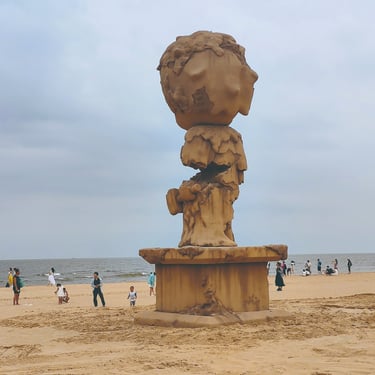
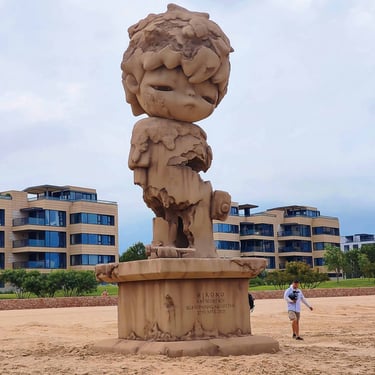
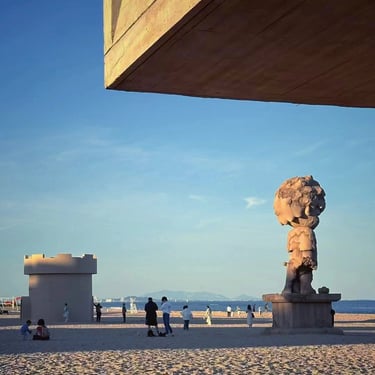
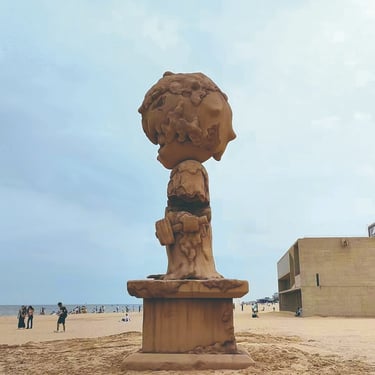
As the opening work of this long-term project, an 8-meter-tall Hirono “Reshape” sculpture, crafted by the DEFARA team, stands prominently on the beach as a monumental anchor for the exhibition. Positioned among sand, sea, architecture, and temporary sandcastle elements, the work creates a distinctive visual dialogue between contemporary art and the natural environment.
More than an enlarged figure, this project was about translating the emotional language of Hirono into a physical landmark. The sculpture needed to preserve the character’s introspective and fragile identity while gaining the permanence, authority, and environmental presence required of a public artwork at monumental scale.
The Challenge
This project presented a unique combination of artistic, technical, and environmental challenges.
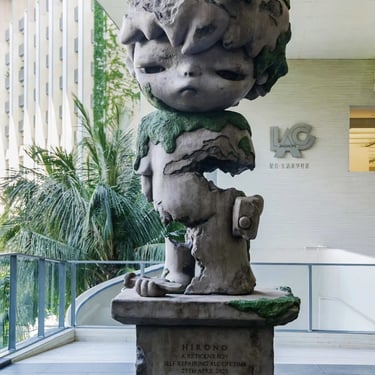
First, Hirono is a character defined not by aggressive visual complexity, but by mood, silence, and subtle emotional tension. The challenge was not simply to reproduce a recognizable form. It was to preserve the emotional nuance of the original artwork while enlarging it to an architectural scale. The proportion of the head, the downcast gaze, the damaged body language, and the quiet symbolic power of the figure all had to remain intact.
Second, the sculpture was installed in a coastal environment. A beach site creates special requirements for large-scale fabrication: resistance to wind, moisture, salt exposure, and public interaction. The structure also needed to be engineered for stability on site while maintaining a clean and refined visual presence.
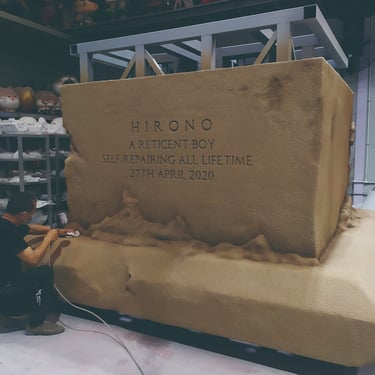
Third, the work’s surface treatment was essential to the concept. The piece carries a weathered, eroded, partially broken appearance that suggests memory, time, vulnerability, and ongoing repair. Achieving this effect at 8 meters tall required careful control of texture, sculptural depth, finishing layers, and material expression so that the final result would feel intentional, immersive, and believable from both near and far.
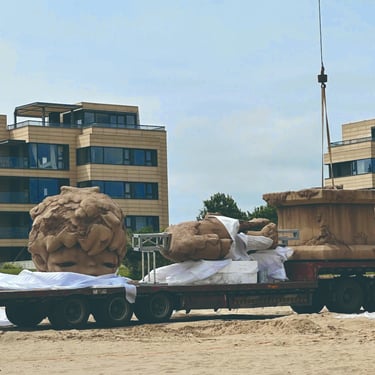
Finally, logistics and installation added another level of complexity. A sculpture of this scale required modular fabrication, controlled transport, and precise on-site assembly to ensure the finished work performed as both an artwork and a long-term outdoor installation.
DEFARA’s Approach
Artistic Translation & Character Integrity
At the heart of the project was the need to protect the essence of Hirono.
DEFARA approached the sculpture not as a generic large figure, but as a character-led artwork with emotional meaning. Great care was taken in translating the original proportions, pose, and facial expression into a monumental format. The low gaze, quiet posture, and partially broken form were all essential to the work’s identity.
Because the visual language of Hirono relies on restraint, subtlety became a major design discipline. The sculpture had to remain emotionally powerful without becoming exaggerated. This balance is especially important in IP-based art fabrication, where accuracy is not only about shape, but also about mood and narrative fidelity.
Structural Engineering & Modular Fabrication
An 8-meter sculpture in an outdoor coastal environment requires serious structural planning beneath its artistic surface.
DEFARA developed the project using a modular fabrication strategy, allowing the sculpture to be manufactured in sections, transported efficiently, and assembled accurately on site. This approach also helped manage the scale of the piece while maintaining strict control over surface continuity and final proportions.
Internal structural engineering was critical. The sculpture had to support its own height, preserve balance across the enlarged head and body proportions, and withstand environmental exposure over time. Stability, load-bearing performance, and installation safety were integrated into the fabrication process from the earliest stage.
This is where large-scale art fabrication moves beyond sculpture making and becomes a form of engineering. The visual effect depends on what cannot be seen: the internal framework, connection systems, and fabrication discipline that allow the work to perform reliably in the real world.
Materials & Surface Finishing
The material language of this project was central to its success.
The Hirono “Reshape” sculpture was designed to evoke a weathered, almost archaeological presence — as if the figure had emerged from time, erosion, and emotional repair. DEFARA translated this concept into a highly controlled textured finish that mimics aged stone and worn surfaces while remaining suitable for long-term display.
This required far more than applying a rough texture. Surface finishing had to be developed to create the right balance of mass, softness, damage, and aging. Cracks, broken edges, material loss, softened contours, and tonal depth all contributed to the final effect. At close range, the sculpture needed to reward observation with detail. At long range, it needed to retain a strong silhouette and visual authority.
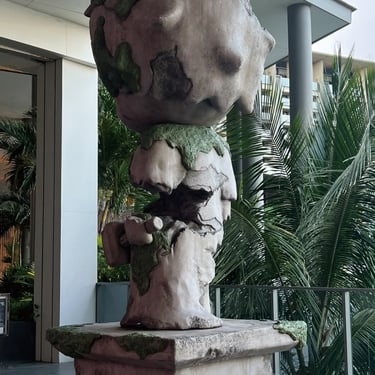
In later environmental adaptations, the project also demonstrated how surface treatment could evolve further through the addition of moss-like detailing and more architectural spatial integration, extending the “Reshape” concept into different site conditions while preserving the original artistic logic.
Installation & Site Execution
Installing a monumental sculpture on a beach requires precision beyond the workshop.
Aranya Beach is a powerful setting, but it is also a sensitive and exposed one. The installation process had to account for transport access, assembly sequence, lifting coordination, and site protection, while ensuring the sculpture would ultimately appear seamless and natural in its surroundings.
DEFARA coordinated on-site installation with a focus on both technical accuracy and visual composition. The sculpture’s position relative to the sea, open sand, surrounding architecture, and visitor movement was a crucial part of the project’s success. The piece was not simply placed on site; it was carefully integrated into a broader visual environment.
The final installation achieves exactly that. It stands as a singular landmark while still feeling connected to the beach, the sky, and the quiet spatial character of Aranya.
Environmental Integration & Long-Term Project Value
One of the strongest aspects of this project is how naturally the sculpture integrates with its location.
The theme “Reclusive in the Wild” is not expressed only through curatorial language. It is embodied in the installation itself. The beach environment, the sandcastle references, the openness of the horizon, and the calm emotional posture of Hirono all work together to form a coherent spatial experience.
As the opening work of a long-term project, the sculpture also carries strategic value beyond its artistic role. It establishes a visual identity for the exhibition, creates a memorable point of arrival, and sets a clear standard for how the Hirono “Reshape” project can live in real space. This is an important aspect of fabrication-led exhibition work: the opening piece is not only an object, but also a statement of intent.
Commercial & Cultural Impact
The Hirono “Reshape” sculpture quickly became a visual landmark on Aranya Beach.
From a public and cultural perspective, the work transforms the exhibition into a place-based experience. It takes a beloved artistic character and allows audiences to encounter it at a scale and in an environment that changes how the work is felt. The result is not only recognizable, but memorable. The sculpture encourages observation, photography, discussion, and emotional connection.
From a commercial perspective, the project strengthens the destination value of the exhibition and the site itself. Large-scale landmark sculpture has a strong ability to drive public attention, amplify social visibility, and enhance audience engagement. In a setting like Aranya, where architecture, nature, and cultural lifestyle already hold strong appeal, a piece of this quality adds a new layer of identity and attraction.
The work also demonstrates how art exhibitions can benefit from fabrication quality that goes beyond display and enters the realm of placemaking. When a sculpture becomes a landmark, it extends the value of the exhibition into tourism, branding, and broader cultural visibility.
Why This Project Matters
This project matters because it shows what happens when emotional art is treated with serious fabrication discipline.
The Hirono “Reshape” sculpture is not valuable simply because it is large. It is valuable because its scale is meaningful. DEFARA’s role was to make sure that the enlargement of the work did not weaken its emotional content, but instead deepened its impact through structure, materiality, and environmental integration.
It is also a strong example of how contemporary art IP, collectible culture, and public space can intersect in a powerful way. The project bridges sculpture, exhibition design, scenic integration, and engineering. It demonstrates that fabrication is not only a production process, but a creative partner in making art function in the physical world.
For DEFARA, this case reflects the company’s ability to deliver large-scale art and IP-driven installations that demand not only manufacturing skill, but also artistic sensitivity, structural competence, and site execution capability.
Conclusion
The Hirono “Reshape” Art Exhibition at Aranya Beach is a compelling example of large-scale art fabrication done with both emotional intelligence and engineering precision.
From the 8-meter hero sculpture to its material language, environmental placement, and long-term exhibition significance, the project shows how a fabricated artwork can become more than an installation. It can become a landmark, a narrative device, and a meaningful part of a site’s cultural identity.
At DEFARA, this is the kind of work we are committed to delivering: projects where artistry and fabrication support one another, where structure strengthens storytelling, and where public artworks are built to resonate both visually and culturally.
For curators, developers, brand owners, and public art partners looking for a trusted global fabrication partner, this project reflects what DEFARA brings to the table: precision, reliability, material intelligence, and the ability to turn concept into place.
Adelaide
Chengdu


DEFARA © 2026
8 TEMASEK BOULEVARD
#08-05, SUNTEC TOWER THREE
038-998 SINGAPORE
Singapore


30 PIRIE STREET
ADELAIDE 5000 SA
AUSTRALIA
1210 FU NIAN PLAZA
HIGH TECH DISTRICT CHENGDU
610000 CHINA
SUITE 703, NORTH TOWER
1-5 RAILWAY STREET
CHATSWOOD 2067
AUSTRALIA
Sydney